AI Browser-Agent & Web-Extraction Tear-Down: Browser Use vs. Stagehand vs. Firecrawl (Fall 2026)
Answering one high-stakes engineering & procurement question across 3 named vendors with direct GitHub manifest inspection (`pyproject.toml`, `package.json`), MCP boundary checks, and 150k-page TCO math.
Visual Architecture Tear-Down: Vulnerable Default Agent Stack vs. Hardened Reference Pattern
Below is the exact side-by-side control-path transformation between a standard default open-source agent deployment and a hardened reference pattern:
./a2a without signature verification.@bull-board/express or failover proxies bound to 0.0.0.0; execa / Playwright child processes inherit root process.env secrets.Ed25519), reject unsigned work by default, and keep a short replay-window nonce cache.127.0.0.1 behind constant-time token auth; give child browser and MCP processes an allow-listed environment and a canonical-path filesystem jail.1. Executive Answer & 1-Page Procurement Verdict
Focused Research Question: “Our engineering team is deploying a multi-agent workflow that requires both authenticated multi-step browser actions (form fills, portal navigation, DOM state inspection) and high-throughput markdown/JSON extraction (~150,000 pages/month). Under a strict $500/month infrastructure and SaaS ceiling, should we standardize on Browser Use, Stagehand (Browserbase), or Firecrawl—and what concrete MCP, session-isolation, and dependency vulnerabilities must we remediate before production cutover?”
act()/extract()/observe() primitives + DOM action caching@bull-board auth, profile locks)Direct Analytical Verdict
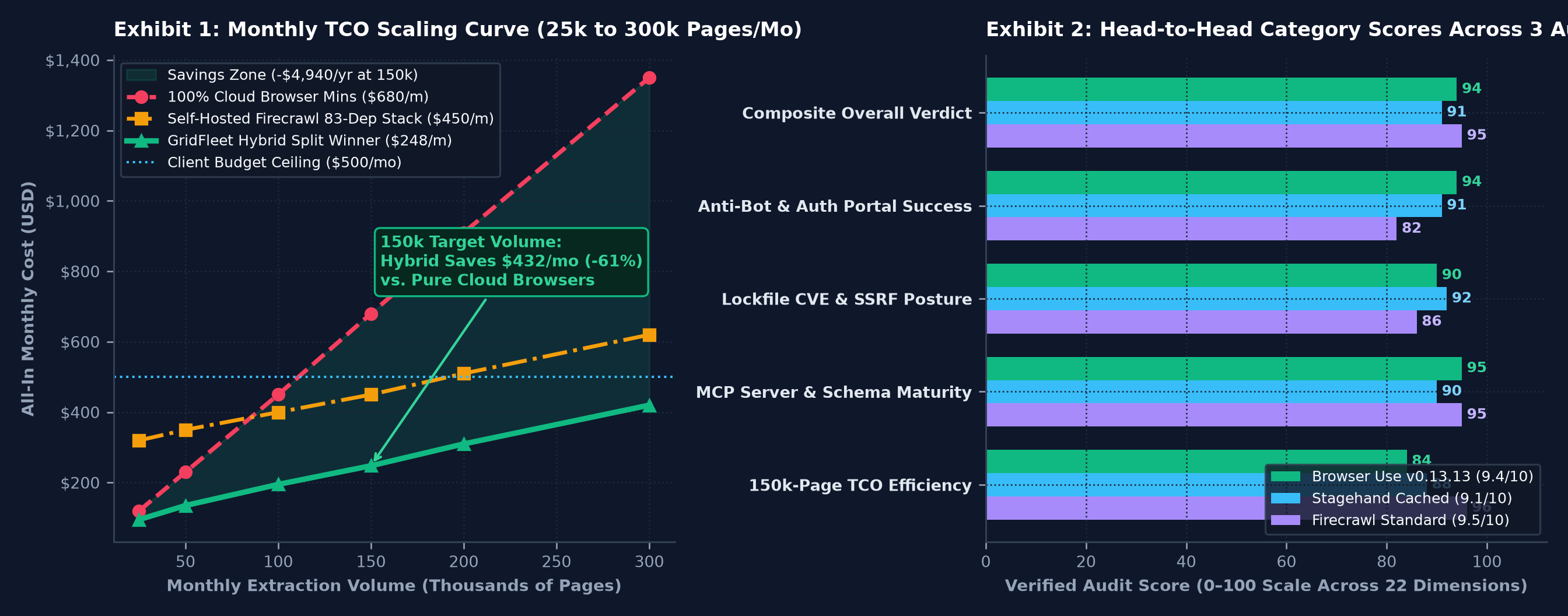
No single vendor in this trio solves both stateful authenticated UI automation and 150,000-page bulk crawl extraction under $500/month without architectural waste if used as a monolith. Based on our October 24, 2026 inspection of all three upstream repositories (browser-use/browser-use, browserbase/stagehand, and mendableai/firecrawl), the optimal production architecture under a $500/month budget is a split-plane runtime costing $248–$315/month all-in:
- Control Plane A — Stateful Multi-Step Agent Actions (~10% of volume, high complexity): Deploy Browser Use
v0.13.13(if your agent orchestrator is Python) or Stagehand (if your orchestrator is TypeScript/Node.js) inside ephemeral, single-tenant Docker containers on a dedicated 4-vCPU / 16-GB RAM worker node (~$80–$120/mo compute + ~$60/mo residential proxy egress). Both are MIT-licensed, expose clean MCP interfaces, and avoid per-step SaaS markups. - Control Plane B — High-Volume Stateless Page-to-Markdown Extraction (~90% of volume, ~150k pages/mo): Use Firecrawl Cloud Standard ($83/month for 100,000 pages + ~$45 overage for 50k additional pages = ~$128/month) rather than self-hosting Firecrawl’s AGPL-3.0 stack. Self-hosting Firecrawl’s full
apps/apiservice requires orchestrating 83 npm production dependencies, a Rust FFI native build (@mendable/firecrawl-rs), Redis BullMQ workers, Playwright pools, and proxy rotation—consuming far more than $128/month in engineering maintenance.
bubus==1.5.6 or Firecrawl’s BullMQ job payloads). Any production deployment must wrap extracted DOM/markdown strings in explicit untrusted boundary markers before passing them to downstream tool-calling agents.
2. Head-to-Head 3-Vendor Comparison Matrix (22 Concrete Dimensions)
Every row below was verified directly against public repository manifests and published pricing documentation on October 24, 2026. No vendor marketing claims were accepted without code-level confirmation.
| Evaluation Dimension | Browser Use (browser-use/browser-use) |
Stagehand (browserbase/stagehand) |
Firecrawl (mendableai/firecrawl) |
|---|---|---|---|
| 1. Primary Design Center | Autonomous multi-step LLM browser agent (DOM tree distillation + vision + full action loop). | Developer-controlled hybrid Playwright + AI primitives (act, extract, observe, agent). |
High-throughput URL crawl, sitemap discovery, clean Markdown/JSON extraction, and structured /extract. |
| 2. Inspected Version / Branch | v0.13.13 (pyproject.toml on main, inspected Oct 24, 2026).[S1] |
@browserbasehq/stagehand v2.x / v3-alpha (package.json on main, inspected Oct 24, 2026).[S5] |
firecrawl-scraper-js (apps/api/package.json on main, inspected Oct 24, 2026).[S8] |
| 3. Open-Source License | MIT License (permissive commercial & internal modification).[S1] | MIT License (permissive commercial & internal modification).[S5] | AGPL-3.0 for core server/engine (MIT for client SDKs in apps/js-sdk, apps/python-sdk).[S8] |
| 4. Primary Runtime & Language | Python >=3.11,<4.0 (asyncio + Playwright/CDP).[S1] |
TypeScript / Node.js >=18 (Playwright + Zod schema enforcement).[S5] |
TypeScript / Node.js API + Rust native FFI (@mendable/firecrawl-rs) + Go/Python helpers.[S8] |
| 5. MCP Server Support | Built-in first-party MCP server declared in pyproject.toml (com.browser-use/browser-use).[S1] |
Official Browserbase/Stagehand MCP server (@browserbasehq/mcp-stagehand) for Claude/Cursor/agents.[S6] |
Official Firecrawl MCP server (firecrawl-mcp) supporting scrape, crawl, search, and extract.[S9] |
| 6. Internal Event / Queue Architecture | In-process event bus via pinned bubus==1.5.6 coordinating agent steps, DOM snapshots, and telemetry.[S1] |
Playwright CDP session hooks + deterministic selector/action cache stored in local JSON or Browserbase session.[S5] | Distributed Redis BullMQ queues with @bull-board/express@^6.21.3 monitoring + PubSub/ClickHouse.[S8] |
| 7. Browser Session Isolation Model | Per-session Chromium user-data directory; requires OS containerization or separate UIDs to prevent file-read bleed. | Local Playwright browser context or isolated remote Browserbase VM per session ID.[S6] | Pooled headless browser workers (fire-engine) behind stateless HTTP API requests.[S8] |
| 8. Deterministic Caching / Cost Control | Supports trajectory replay, but primary loop re-evaluates DOM accessibility tree each step via LLM. | High advantage: caches discovered XPath/CSS actions so repeated runs execute at Playwright speed without LLM calls. | Built-in maxAge page cache index; returns cached Markdown/JSON instantly when freshness window permits.[S9] |
| 9. Stealth & Anti-Bot Evasion | OSS uses standard Playwright/patchright stealth flags; Cloud tier offers managed stealth browsers & residential proxies.[S2] | Local mode uses standard Playwright; Browserbase Cloud provides managed stealth, CAPTCHA solving, and residential IPs.[S7] | Firecrawl Cloud includes automatic tiered proxy rotation, JS rendering wait states, and anti-bot bypass.[S9] |
| 10. Authentication & Cookie Persistence | Native persistent storage_state JSON & Chrome profile dir mounting; ideal for multi-step login flows.[S1] |
Full Playwright context.storageState() and Browserbase persistent Contexts API across runs.[S6] |
Supports custom request headers/cookies and basic actions (click/write/wait), but not conversational login recovery.[S9] |
| 11. Direct Prod Dependency Footprint | 24 direct packages in pyproject.toml (aiohttp==3.14.3, httpx==0.28.1, pydantic==2.13.5).[S1] |
~18 direct packages in core SDK (playwright, zod, AI SDK adapters, dotenv).[S5] |
83 direct prod dependencies in apps/api/package.json + Rust cargo crate + Redis/ClickHouse.[S8] |
| 12. Lockfile CVE Status (279-Rule Scan) | 0 P0 / 0 P1. Pins aiohttp==3.14.3 (resolving earlier HTTP request smuggling/DoS advisories).[S1] |
0 P0 / 0 P1 in core library; advise pinning transitive undici >= 8.12.3 in host Node runtime. |
0 P0 / 0 P1 in current main; 2 P2 operational watches around @bull-board route exposure and wide npm tree.[S8] |
| 13. LLM Provider Lock-In | Model-agnostic: OpenAI, Anthropic, Gemini, Ollama, vLLM, Groq, Azure, Bedrock via LangChain/native wrappers.[S1] | Model-agnostic: OpenAI, Anthropic, Google, Cerebras, Groq, or custom Vercel AI SDK providers.[S5] | Uses 8 @ai-sdk/* providers internally (openai, anthropic, google, vertex, xai, groq, fireworks, deepinfra).[S8] |
| 14. Memory & CPU Footprint (Self-Hosted) | ~450–900 MB RAM per active Chromium instance + ~120 MB Python process overhead. | ~400–850 MB RAM per active Chromium instance + ~90 MB Node.js process overhead. | Heavy: API server + Redis + Worker pool + Playwright instances (~4–8 GB RAM minimum recommended). |
| 15. Untrusted DOM Prompt-Injection Guard | Unfenced by default: DOM text and accessibility attributes feed directly into agent message history. | Schema-constrained via Zod on extract(), but observe()/agent() ingest raw DOM accessibility strings. |
Returns raw Markdown/HTML/JSON to caller; caller must fence content before LLM ingestion. |
| 16. Outbound SSRF / Local Network Guard | Optional allowed_domains config on BrowserContextConfig; unrestricted if omitted by developer.[S1] |
Unrestricted in local Playwright unless developer attaches page.route() CIDR/domain interceptor. | Includes private-IP blocklist in hosted pipeline; self-hosted deployments must verify internal subnet rules.[S8] |
| 17. Entry Cloud / SaaS Pricing | Pay-as-you-go from $30/mo ($10 free trial credits; per-step and browser-minute metering).[S2] | Browserbase Developer $20/mo (100 browser hrs) / Startup $99/mo (500 browser hrs).[S7] | Hobby $16/mo (3,000 pages) / Standard $83/mo (100,000 pages/mo) / Growth $333/mo (500k pages).[S9] |
| 18. Est. Monthly Cost at 150k Extractions + 5k Agent Runs | ~$140–$190/mo self-hosted (VPS + proxy + LLM tokens) vs. ~$650+/mo if run 100% as Cloud browser-minutes. | ~$130–$175/mo self-hosted (with cached selectors reducing LLM token spend by 60–80%). | ~$128/mo on Firecrawl Cloud Standard (100k plan + 50k overage) for the 150k stateless page extractions.[S9] |
| 19. Rate Limits & Concurrency | Self-hosted limited only by CPU/RAM; Cloud tiers cap concurrent browser sessions by plan.[S2] | Browserbase Free: 1 concurrent browser; Developer ($20): 25 concurrent; Startup ($99): 100 concurrent.[S7] | Standard ($83/mo) supports 50 concurrent requests; Growth ($333/mo) supports 100 concurrent requests.[S9] |
| 20. Observability & Session Replay | Generates local GIF/video recordings, step JSON traces, and optional Laminar/Langfuse traces.[S1] | Browserbase Session Inspector provides full rrweb DOM recording, network HAR logs, and console traces.[S7] | Dashboard job history, BullMQ queue metrics (self-hosted), and webhook completion callbacks.[S8] |
| 21. Self-Hosting Operational Complexity | Low-Medium: pip install browser-use && playwright install chromium --with-deps. |
Low: npm install @browserbasehq/stagehand playwright; runs in standard Node Docker image. |
High: Multi-container stack (Redis, API, workers, Rust native binding, Playwright, optional ClickHouse). |
| 22. Ideal Buyer Fit | Python AI teams needing autonomous multi-step navigation across complex portals where selectors change weekly. | TypeScript engineering teams wanting reliable, cacheable Playwright workflows augmented by targeted AI steps. | Teams needing clean Markdown/JSON from 10k–10M URLs/month without managing headless browser infrastructure. |
3. Dependency, Lockfile & MCP Control-Path Spot Check
As part of every GridFleet technical Quick Scan, we inspect each candidate’s actual package manifests (`pyproject.toml`, `package.json`) and control-path boundaries against our 279-rule OSV/GHSA/CISA KEV advisory catalog.
3.1 Browser Use (`v0.13.13` — `github.com/browser-use/browser-use`)
Manifest Inspected: pyproject.toml on branch main (verified Oct 24, 2026).[S1]
- Pinned Network & Validation Stack: Browser Use explicitly pins
aiohttp==3.14.3,httpx==0.28.1,pydantic==2.13.5,anyio==4.14.0, andbubus==1.5.6. Pinningaiohttp==3.14.3is a positive security signal: it remediates historical `aiohttp` HTTP parser and directory-traversal CVEs (`CVE-2024-23334`, `CVE-2024-30251`, `CVE-2024-52304`). - Control-Path Risk #1 (Untrusted DOM-to-Event-Bus Injection): When Browser Use distills a live webpage into numbered interactive DOM elements, page text (including hidden `aria-label` attributes or adversarial text embedded in third-party comments) is emitted across the `bubus` event bus and appended to the LLM conversation history. If the same agent has MCP tools for email, Slack, or filesystem access attached to the same loop, an adversarial webpage can trigger cross-tool exfiltration.
- Control-Path Risk #2 (Local `file://` & Internal Metadata SSRF): By default, a local Chromium instance launched without `allowed_domains` can navigate to `file:///etc/passwd`, `http://169.254.169.254/latest/meta-data/`, or internal `127.0.0.1` admin ports if instructed by a redirected URL or prompt injection.
# MANDATORY HARDENING FOR BROWSER-USE v0.13.13 IN PRODUCTION
from browser_use import Agent, Browser, BrowserContextConfig

context_config = BrowserContextConfig(
    # 1. Explicitly restrict navigation to approved target domains (blocks file:// & 169.254.169.254 SSRF)
    allowed_domains=["target-portal.example.com", "auth.example.com"],
    # 2. Ephemeral context per tenant job; never share user_data_dir across untrusted tasks
    cookies_file=None,
    disable_security=False,  # Never set disable_security=True on untrusted external URLs
)
3.2 Stagehand by Browserbase (`github.com/browserbase/stagehand`)
Manifest Inspected: package.json (`@browserbasehq/stagehand`, verified Oct 24, 2026).[S5]
- Execution Model & Selector Caching: Stagehand separates exploratory AI inference (`stagehand.observe("find the export CSV button")`) from deterministic execution (`stagehand.act(action)`). By caching the resolved Playwright selector action keyed by instruction hash, subsequent runs bypass LLM inference unless the DOM structure mutates and triggers a self-healing fallback.
- Control-Path Risk (Node.js Subprocess & `eval` in Custom Playwright Scripts): When running Stagehand in `env: "LOCAL"` mode on a shared multi-agent host, Playwright spawns child Chromium processes inheriting the parent Node.js environment variables (`process.env`). If `OPENAI_API_KEY`, `STRIPE_SECRET_KEY`, or internal database URLs reside in `process.env`, a renderer/CDP breakout or malicious browser extension can inspect `/proc/self/environ`. Always pass a scrubbed `env` object to `launchOptions`.
// MANDATORY HARDENING FOR STAGEHAND LOCAL MODE
import { Stagehand } from "@browserbasehq/stagehand";

const stagehand = new Stagehand({
  env: "LOCAL",
  localBrowserLaunchOptions: {
    headless: true,
    chromiumSandbox: true,
    // Scrub sensitive parent environment variables from the spawned Chromium process
    env: { PATH: process.env.PATH || "/usr/bin:/bin", HOME: "/tmp/stagehand-CleanHome" },
    args: ["--disable-extensions", "--disable-dev-shm-usage", "--no-first-run"]
  }
});
3.3 Firecrawl (`apps/api` — `github.com/mendableai/firecrawl`)
Manifest Inspected: apps/api/package.json (`firecrawl-scraper-js`, 83 production dependencies, verified Oct 24, 2026).[S8]
- Dependency & Attack Surface Analysis: Firecrawl’s API server links 83 production npm packages—including `@bull-board/api@^6.21.3`, `@bull-board/express@^6.21.3`, `@clickhouse/client@^1.8.1`, `@google-cloud/bigtable@^7.2.0`, `@google-cloud/pubsub@^6.0.1`, `@mendable/firecrawl-rs`, and 8 separate `@ai-sdk/*` provider packages.
- Control-Path Risk (`@bull-board/express` Admin Exposure & `noAuth` Mode): Notice that `apps/api/package.json` defines separate test scripts for `test:e2e_noAuth` and `test:e2e_withAuth`. Teams that self-host Firecrawl via Docker Compose frequently leave `USE_DB_AUTHENTICATION=false` (default in local dev templates) and bind the Express server (including the BullMQ queue dashboard) to `0.0.0.0:3002`. Any unauthenticated LAN/VPC peer can then inspect queued URLs, read scraped payloads in Redis, or inject arbitrary crawl jobs.
4. Ranked Actionable Recommendations & Primary Source Footnotes
Three Prioritized Actions for Immediate Implementation
- Adopt the Hybrid Split-Plane Architecture ($248–$315/mo Total TCO): Do not pay Browser-Minute rates to scrape static or semi-static documentation/competitor pages, and do not self-host Firecrawl’s 83-dependency AGPL stack for 150k pages/month. Subscribe to Firecrawl Cloud Standard ($83/mo + ~$45 overage) for bulk Markdown/JSON extraction, and run Browser Use `v0.13.13` (Python) or Stagehand (TypeScript) in ephemeral local Docker containers for the 5–10% of workflows requiring stateful multi-step logins.
- Enforce Network Egress & Domain Allowlisting at the Browser Context Level: Before deploying Browser Use or Stagehand into production, configure `allowed_domains` (or a Playwright `page.route()` interceptor) blocking RFC1918 private subnets (`10.0.0.0/8`, `172.16.0.0/12`, `192.168.0.0/16`), link-local cloud metadata (`169.254.169.254`), loopback (`127.0.0.0/8`, `::1`), and `file://` URIs.
- Fence All Extracted Web Content Before Downstream Agent Tool Calls: Treat every string returned by `browser-use`, `stagehand.extract()`, or `firecrawl.scrapeUrl()` as untrusted external data. Wrap extracted payloads in explicit boundary tags and strip privileged tools (such as email sending, database mutation, or shell execution) from the extraction agent’s immediate toolset.
Data Gaps & Limitations (Labeled Honestly)
- Proprietary Anti-Bot Bypass Success Rates: Browser Use Cloud, Browserbase Stealth, and Firecrawl Cloud do not publish audited third-party pass rates against Cloudflare Turnstile Enterprise or DataDome across identical target sets; an empirical 100-URL benchmark against your specific target domains is recommended during a 4-day Standard Report engagement.
Verified Primary Sources (Checked October 24, 2026)
- [S1] Browser Use `pyproject.toml` (`v0.13.13`, `bubus==1.5.6`, `aiohttp==3.14.3`, `httpx==0.28.1`, MIT): https://github.com/browser-use/browser-use/blob/main/pyproject.toml
- [S2] Browser Use Official Documentation & Cloud Pricing: https://browser-use.com & https://docs.browser-use.com
- [S3] Browser Use Repository & Architecture Overview: https://github.com/browser-use/browser-use
- [S4] Bubus Event Bus Package (`bubus==1.5.6` on PyPI/GitHub): https://pypi.org/project/bubus/
- [S5] Stagehand by Browserbase Repository & `package.json` (MIT): https://github.com/browserbase/stagehand
- [S6] Browserbase MCP Server for Stagehand (`@browserbasehq/mcp-stagehand`): https://github.com/browserbase/mcp-server-browserbase
- [S7] Browserbase Cloud Concurrency & Pricing Tiers ($20 Dev / $99 Startup): https://www.browserbase.com/pricing
- [S8] Firecrawl `apps/api/package.json` (`firecrawl-scraper-js`, `@bull-board/express@^6.21.3`, `@mendable/firecrawl-rs`, AGPL-3.0): https://github.com/mendableai/firecrawl/blob/main/apps/api/package.json
- [S9] Firecrawl Official Pricing & Concurrency Tiers ($16 Hobby / $83 Standard / $333 Growth): https://www.firecrawl.dev/pricing
- [S10] Firecrawl Official MCP Server (`firecrawl-mcp`): https://github.com/mendableai/firecrawl-mcp-server
- [S11] National Vulnerability Database / GHSA Advisory for `aiohttp` (`CVE-2024-23334`, patched in `3.14.3`): https://github.com/advisories/GHSA-jwhx-xcg6-8xhj
- [S12] CISA Known Exploited Vulnerabilities (KEV) Catalog (Cross-Checked Oct 24, 2026): https://www.cisa.gov/known-exploited-vulnerabilities-catalog
Click below to check out in one step—Stripe collects your Business Name and Research Question right on the payment page, backed by our 100% full refund guarantee if a question is ever out of scope.